Can Touch Hurt Migraine?

One troublesome symptom of migraine is skin hypersensitivity during an episode, a condition called allodynia. Anything touching the skin and even the hair—a hat, clothing, eyeglasses—can feel painful or overwhelming. 

A migraine sufferer might avoid touch therapy for fear it could cause more pain, which is possible with a massage that uses movement, too much pressure, or works too quickly, especially with a body holding chronic tightness, tension, and myofascial pain.

The Mundo Method approach is unique; this very gentle touch protocol modulates, quiets, stills, and releases a migraine’s sensations during an episode, along with accompanying symptoms. Interestingly, the protocol uses mind-body techniques to move toward instead of away from the pain to conquer it.

Early on in my experience, my hands would naturally find the heart of the pain on someone’s head (and my own) without thinking about it. When I transcribed into written instructions two decades of hands-on headache knowledge, my clients were able to relieve their own migraines. Around this I created my comprehensive relief and prevention Mundo Program because why suffer?

In 2006 I added phone and video sessions and found I could teach the protocol even without the benefit of in-person touch training, which later proved essential during pandemic times.

This means that when you are too sick with migraine to go get help, you can help yourself and turn your day around! I am grateful and amazed to have had this powerful, natural migraine therapy for fifty years that helps so many people (and me) to heal their pain, minus side effects.

Want to learn how? Schedule a 30-minute FREE Headache Detective Call with Headache Coach, Jan Mundo. (It’s on Healthie, where I manage my practice and take great care of my clients.) 

Don’t wait! Believe it or not, the work is fun, you will learn so much about yourself and living a balanced life, and once you’re done, you’re done!

Want to know what that means? Let’s talk!

Engaging Embodiment Conference

I am honored to present a live online session at the international conference Engaging Embodiment: Somatic Applications for Health, Education & Social Justice

The conference is being held March 3-7, 2021, live online, with taped replays and is co-sponsored by ISMETA (International Somatic Movement Education and Therapy Association) and Pacifica Graduate Institute. Filled with talks and experiential workshops led by inspiring pioneers, leaders, teachers, and expert practitioners in the field of Somatics!

Cost is $125 members, $150 non-members. Video replays are available for one year. If attending live, check time converter for your time zone.

Even if you sign up now in the final two days of the conference, you can have access to the video replays all year. This conference holds a wealth of information and experiences for somatic professionals, related fields of psychology, movement, dance, occupational therapy, and more.

My session is A Somatic Journey at the Intersection of Headaches, Migraine, Myofascial Pain, and Awareness, Saturday, March 6, 10:10 am PDT. The video replays are posted approximately 24 hours after the live presentation.

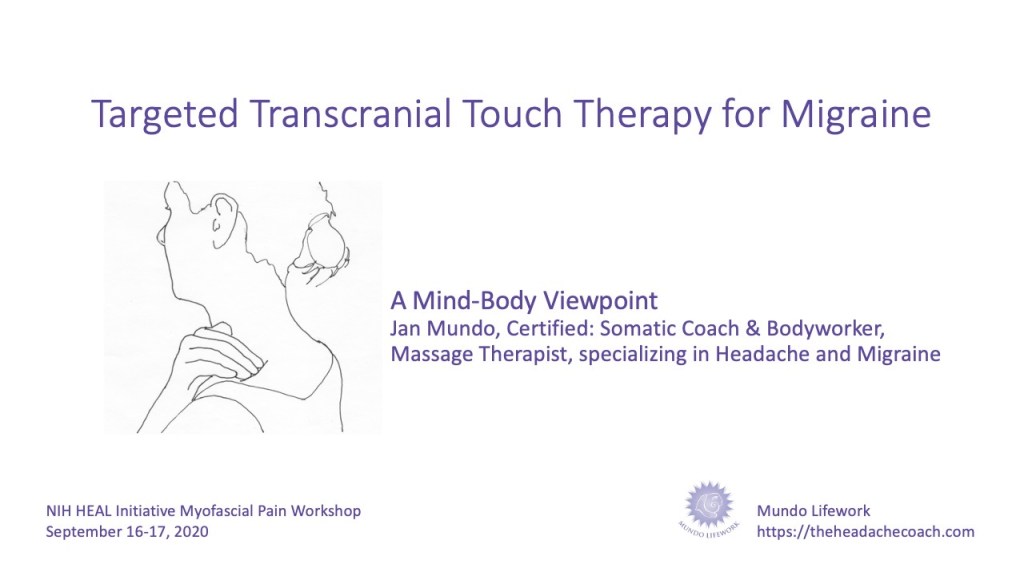
NIH Panel Presentation on Transcranial Touch Therapy for Migraine

* To View this 3-page presentation, please click image to download it.

I was honored to present a clinical, mind-body perspective about migraine in a panel presentation at the NIH HEAL (Helping to End Addiction Long-term℠) Initiative’s Myofascial Pain Workshop (virtual) on September 16-17, 2020. The HEAL initiative is exploring ways to help end the U.S. opioid epidemic with non-drug therapies.

Myofascial pain is prevalent in migraine patients, and my presentation introduced a “Targeted Transcranial Touch Therapy for Migraine” (aka Mundo Method) and research about the intersection of touch, tactile attention, fascia, pain, and the brain.

The presenters, clinicians, researchers, and scientists hailed from preeminent universities, colleges, medical centers, and the NIH to discuss the properties of musculoskeletal pain, fascia, the nervous system, and cutting-edge imaging and measurement technologies with a view toward understanding and measuring myofascial pain.